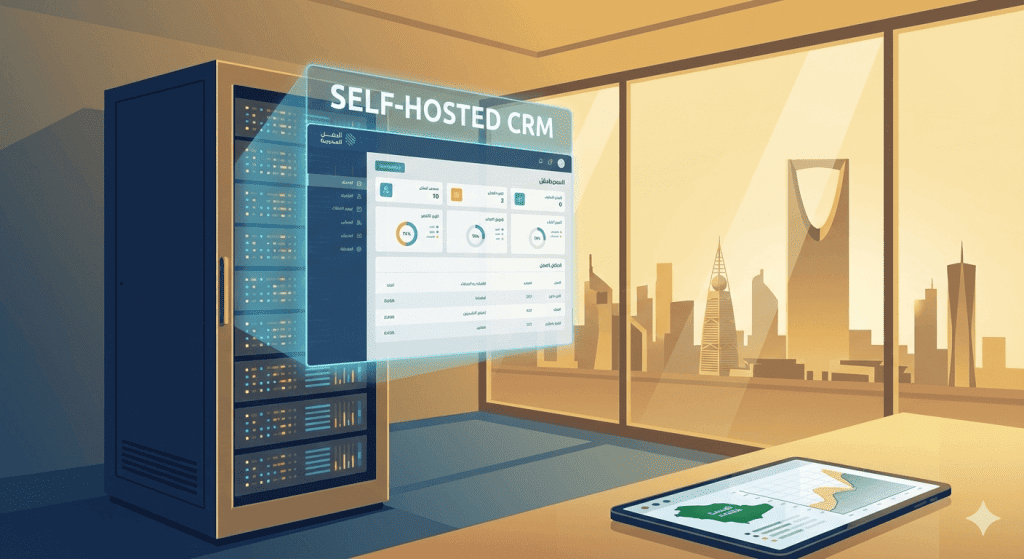
Saudi Arabia’s digital economy is accelerating under Vision 2030, and businesses across Riyadh, Jeddah, Dammam, and emerging smart cities are investing heavily in self-hosted CRM systems with automation. From SMEs to large enterprises, organisations now prioritise data control, local compliance, workflow automation, and scalability over generic cloud-only solutions.
This guide delivers a 2026-ready, expert breakdown of the best self-hosted CRM setup and automation systems in Saudi Arabia, including software comparisons, automation capabilities, CRM types, and practical decision frameworks — written for real decision-makers, not algorithms.
Short answer: The best self-hosted CRM options in Saudi Arabia include SuiteCRM, Odoo (Community), EspoCRM, Dolibarr, and others that offer full control over data, secure on-premise hosting, and custom workflows without subscription lock-in. This guide compares features, deployment options, customization, and best use cases for local businesses.
Looking for a secure, self-hosted CRM for your business in Saudi Arabia?
Get expert guidance on selecting, hosting, and customizing the right CRM — without vendor lock-in or unnecessary costs.
Get Free CRM GuidanceBest Self-Hosted CRM Comparison Table
| CRM Tool | License | Key Modules | Deployment | Customization | Support Ecosystem | Best Fit |
|---|---|---|---|---|---|---|
| SuiteCRM | MIT (Open Source) | Sales, Support, Marketing | On-Premise / Cloud | High | Large community | SMBs & Enterprises |
| Odoo (Community) | Open Core | CRM, Sales, Billing | Cloud / On-Premise | High | Large community + partners | SMBs |
| EspoCRM | GPL | Sales, Dashboards | On-Premise | Moderate | Active GitHub | SMBs |
| Dolibarr | GPL | CRM + ERP Modules | On-Premise / Cloud | Low | Moderate users | Small Businesses |
| SuiteDash (Self Hosted) | Proprietary | CRM, Client Portals | Cloud / VPS | Moderate | Paid support | Agencies & SMEs |
Not sure which self-hosted CRM is perfect for your business in Saudi Arabia?
Get Free CRM RecommendationWhy Self-Hosted CRM Systems Are Gaining Popularity in Saudi Arabia
Self-hosted CRM solutions allow organisations to deploy customer management platforms on private servers or local cloud infrastructure, offering higher control and flexibility.
Key reasons Saudi businesses prefer self-hosted CRMs:
- 1. Data residency & compliance with local regulations
- 2. Custom workflow automation aligned with internal processes
- 3. Lower long-term ownership costs
- 4. Integration with ERP, finance, and legacy systems
- 5. Greater security and role-based access control
For sectors such as government, healthcare, real estate, manufacturing, and finance, self-hosting is no longer optional — it’s strategic.
What Are the 4 Types of CRM Systems?
Understanding CRM categories helps businesses select the right platform, not just the most popular one.
| CRM Type | Purpose | Key Benefits |
| Operational CRM | Automates sales, marketing & support | Lead management, workflows, task automation |
| Analytical CRM | Analyses customer data | Reporting, forecasting, insights |
| Collaborative CRM | Improves internal communication | Cross-team visibility, customer history |
| Strategic CRM | Long-term customer value | Retention, loyalty, personalised engagement |
Best practice for 2026:
The most effective platforms combine all four types in one system — reducing tool sprawl and improving ROI.
Top 10 CRM Software Options in Saudi Arabia (Self-Hosted & Automation-Ready)
Below is a 2026 comparison of the most relevant CRM platforms used in Saudi Arabia, focusing on self-hosting, automation, scalability, and localisation.
CRM Software Comparison Table
| CRM Software | Self-Hosted | Automation | Best For | Key Strength |
| Odoo CRM | Yes | Advanced | SMEs & Enterprises | Full ERP + CRM |
| SuiteCRM | Yes | Strong | Cost-sensitive orgs | Open-source flexibility |
| Zoho CRM (On-Prem) | Limited | Advanced | Growing businesses | Usability + automation |
| EspoCRM | Yes | Moderate | SMEs | Lightweight & custom |
| Vtiger CRM | Yes | Advanced | Sales teams | Workflow automation |
| Dolibarr | Yes | Basic | Small businesses | Simplicity |
| SugarCRM (Self-Hosted) | Yes | Advanced | Enterprises | Deep customisation |
| ERPNext CRM | Yes | Strong | Manufacturing | ERP-native CRM |
| OroCRM | Yes | Advanced | B2B enterprises | Scalability |
| OpenCRX | Yes | Moderate | Tech teams | High custom control |
Best Self-Hosted CRM with Automation in Saudi Arabia
1. Odoo CRM (Top Choice for 2026)
Odoo stands out due to its modular ERP + CRM architecture, making it ideal for Saudi businesses planning long-term digital transformation.
Why Odoo works well in KSA:
- 1. Fully self-hosted deployment
- 2. Sales, marketing, accounting & inventory integration
- 3. Workflow automation & approvals
- 4. Arabic language support
- 5. Strong local partner ecosystem
2. SuiteCRM (Best Open-Source CRM)
SuiteCRM is popular among organisations seeking cost-effective self-hosting without sacrificing functionality.
Key strengths:
- 1. No licensing fees
- 2. Custom workflows and automation
- 3. Strong reporting
- 4. Ideal for local hosting environments
3. Zoho CRM (Professional Edition – Hybrid Option)
While Zoho is primarily cloud-based, Zoho CRM Professional Edition remains widely adopted in Saudi Arabia due to its automation depth and ease of use.
Zoho CRM Professional Edition Features:
- 1. Workflow rules & approvals
- 2. Sales automation
- 3. Custom modules
- 4. AI-powered insights
- 5. Multi-channel engagement
Is Zoho CRM really free?
Zoho offers a free version for up to 3 users, but automation and advanced reporting require paid editions.
CRM in Action: Real Self-Hosted CRM Use Cases in Saudi Arabia
Use Case 1: Secure Lead Management for a B2B Services Company
A Saudi-based B2B services firm deployed a self-hosted CRM on its own cloud infrastructure to maintain full control over customer data. Website inquiries were automatically captured inside the CRM, routed to sales teams, and tracked without relying on third-party SaaS tools. This eliminated manual data entry and improved response time while keeping all data within company-controlled servers.
Use Case 2: CRM + WhatsApp Integration for a Local Trading Business
A trading company in Riyadh integrated its self-hosted CRM with WhatsApp and email systems. Sales teams could view conversation history, follow up faster, and assign leads automatically. Hosting the CRM internally ensured communication data remained private and aligned with local data-handling policies.
Use Case 3: Customized CRM for Multi-Branch Operations
A growing company operating across multiple Saudi cities used a self-hosted CRM to manage branch-level sales pipelines, role-based access, and reporting. Each branch had controlled access to relevant data, while management gained real-time visibility across operations — something difficult to achieve with off-the-shelf SaaS CRM platforms.
Use Case 4: CRM Integrated with Accounting & ERP Systems
A medium-sized enterprise connected its self-hosted CRM with accounting and ERP systems to streamline invoicing and customer reporting. Sales and finance teams worked from a unified data source, reducing errors and improving operational visibility without recurring subscription costs.
Want a self-hosted CRM like these — built for your business?
Get Free CRM Implementation RoadmapDeployment & Compliance Considerations
When choosing a self-hosted CRM in Saudi Arabia, deployment and compliance are critical. Many decision-makers focus solely on features, but how and where the CRM runs often has a bigger impact on long-term success.
On-Premise vs Regional Cloud Hosting
Self-hosted CRMs can be deployed in multiple ways:
-
1. On-Premise: The CRM is installed on servers that your company owns or rents locally. This gives full control over data, allows complete customization, and avoids third-party dependencies.
-
2. Regional Cloud Hosting: Many businesses prefer hosting on Saudi-based cloud providers or local VPS servers. This ensures lower latency, compliance with regional data laws, and easier scaling without managing physical hardware.
Each option has trade-offs in cost, flexibility, and maintenance. Evaluating them against your team’s capabilities is essential before implementation.
Data Residency Importance
Data residency matters in Saudi Arabia due to local regulations and customer trust. Key considerations include:
-
1.Ensuring customer and sales data stays within Saudi borders
-
2. Maintaining control for audit purposes
-
3. Reducing risk of breaches or compliance violations
Choosing a CRM deployment strategy that respects local data laws builds trust with clients and protects your business from potential fines or legal challenges.
Security Standards
A self-hosted CRM is only as secure as its infrastructure and practices. Businesses must ensure:
-
End-to-end encryption (HTTPS/SSL)
-
Role-based access control for employees
-
Regular backups and disaster recovery plans
-
System hardening to prevent unauthorized access
Proper deployment and adherence to security standards not only protects sensitive business information but also demonstrates professionalism to customers and partners.
Key Takeaway
A CRM’s value is not just in its features—it’s in how safely, reliably, and legally it handles your business data. Understanding deployment options and compliance requirements helps businesses in Saudi Arabia avoid costly mistakes and maximize ROI.
Which Is the Best CRM System for a Small Business in Saudi Arabia?
For small businesses, the ideal CRM should be:
- 1. Easy to deploy
- 2. Affordable
- 3. Automation-ready
- 4. Scalable
Recommended options:
- 1. Odoo CRM (future growth)
- 2. SuiteCRM (budget control)
- 3. EspoCRM (simplicity)
CRM Automation: Why It Matters More in 2026
Automation is no longer about saving time — it’s about consistency, scalability, and intelligence.
Automation use cases:
- 1. Lead assignment
- 2. Follow-up reminders
- 3. Email & WhatsApp workflows
- 4. Sales pipeline updates
- 5. Customer lifecycle tracking
Platforms offering workflow automation consistently outperform manual systems in both conversion rates and customer satisfaction.
Self-Hosted CRM Setup: What Businesses Should Consider
1. Technical Setup Checklist
- 1. Secure server infrastructure (on-prem or private cloud)
- 2. Database optimisation
- 3. Role-based access control
- 4. Backup & disaster recovery
- 5. API integration support
2. Security & Compliance
- 1. Data encryption
- 2. Local hosting compliance
- 3. Audit logs
- 4. User permissions
CRM Trends in Saudi Arabia for 2026
Best trends shaping CRM adoption emphasize self-hosted AI hybrid systems that combine on-premise control with intelligent automation. It enhanced data security and predictive insights. Workflow automation has become standard, streamlining repetitive tasks like lead nurturing and follow-ups to boost efficiency across UAE businesses. ERP-integrated CRMs enable seamless data flow between sales, inventory, and finance modules, while Arabic-first interfaces cater to regional users with native language support and right-to-left layouts. Industry-specific customization tailors platforms like SuiteCRM or PerfexCRM for sectors such as real estate or retail in Sharjah, and local hosting with compliance-first architecture ensures GDPR and UAE data sovereignty adherence.
Which Is the Best CRM System Overall?
There is no universal answer — but for Saudi Arabia in 2026:
- 1. Best all-rounder: Odoo CRM
- Odoo CRM excels as the top all-rounder with its comprehensive suite that seamlessly blends sales pipelines, marketing automation, inventory management, and e-commerce tools into one modular platform. Making it perfect for growing Saudi SMEs seeking an affordable, all-in-one solution without vendor lock-in.
- 2. Best open-source: SuiteCRM
- SuiteCRM leads open-source options by offering full customization freedom, robust community support, and advanced features like AI-driven lead scoring and workflow automation, ideal for Saudi enterprises prioritizing cost savings, data sovereignty through self-hosting, and tailored modules for sectors like oil & gas or retail.
- 3. Best usability: Zoho CRM
- Zoho CRM shines in usability with its intuitive drag-and-drop interface, mobile-first design, and AI assistant Zia that provides predictive sales insights and automation. Delivering a low learning curve that’s especially valuable for Saudi teams handling multilingual customer interactions and rapid onboarding.
- 4. Best ERP-native CRM: ERPNext
- ERPNext stands out as the premier ERP-native CRM, fully embedded within its open-source ERP framework to handle end-to-end operations from CRM leads to accounting and manufacturing. Ensuring real-time data sync and scalability for Saudi manufacturers or distributors navigating complex supply chains.
Final Thoughts:
Selecting the best self-hosted CRM setup and automation system in Saudi Arabia requires balancing control, automation, scalability, and local requirements. Businesses that invest wisely in 2026 will gain better customer visibility, operational efficiency, and long-term competitive advantage.
Ready to Deploy a Secure Self-Hosted CRM?
Tell us your business needs and we’ll design a self-hosted CRM solution tailored for Saudi Arabia — focused on data control, compliance, and growth.
Schedule Free CRM Strategy CallFAQ’s About Best self hosted CRM
Zoho offers a free version for up to 3 users, but automation and advanced reporting require paid editions.
CRM in Action: Real Self-Hosted CRM Use Cases in Saudi Arabia
Use Case 1: Secure Lead Management for a B2B Services Company
A Saudi-based B2B services firm deployed a self-hosted CRM on its own cloud infrastructure to maintain full control over customer data. Website inquiries were automatically captured inside the CRM, routed to sales teams, and tracked without relying on third-party SaaS tools. This eliminated manual data entry and improved response time while keeping all data within company-controlled servers.
Use Case 2: CRM + WhatsApp Integration for a Local Trading Business
A trading company in Riyadh integrated its self-hosted CRM with WhatsApp and email systems. Sales teams could view conversation history, follow up faster, and assign leads automatically. Hosting the CRM internally ensured communication data remained private and aligned with local data-handling policies.
Use Case 3: Customized CRM for Multi-Branch Operations
A growing company operating across multiple Saudi cities used a self-hosted CRM to manage branch-level sales pipelines, role-based access, and reporting. Each branch had controlled access to relevant data, while management gained real-time visibility across operations — something difficult to achieve with off-the-shelf SaaS CRM platforms.
Use Case 4: CRM Integrated with Accounting & ERP Systems
A medium-sized enterprise connected its self-hosted CRM with accounting and ERP systems to streamline invoicing and customer reporting. Sales and finance teams worked from a unified data source, reducing errors and improving operational visibility without recurring subscription costs.
Want a self-hosted CRM like these — built for your business?
Get Free CRM Implementation RoadmapDeployment & Compliance Considerations
When choosing a self-hosted CRM in Saudi Arabia, deployment and compliance are critical. Many decision-makers focus solely on features, but how and where the CRM runs often has a bigger impact on long-term success.
On-Premise vs Regional Cloud Hosting
Self-hosted CRMs can be deployed in multiple ways:
-
1. On-Premise: The CRM is installed on servers that your company owns or rents locally. This gives full control over data, allows complete customization, and avoids third-party dependencies.
-
2. Regional Cloud Hosting: Many businesses prefer hosting on Saudi-based cloud providers or local VPS servers. This ensures lower latency, compliance with regional data laws, and easier scaling without managing physical hardware.
Each option has trade-offs in cost, flexibility, and maintenance. Evaluating them against your team’s capabilities is essential before implementation.
Data Residency Importance
Data residency matters in Saudi Arabia due to local regulations and customer trust. Key considerations include:
-
1.Ensuring customer and sales data stays within Saudi borders
-
2. Maintaining control for audit purposes
-
3. Reducing risk of breaches or compliance violations
Choosing a CRM deployment strategy that respects local data laws builds trust with clients and protects your business from potential fines or legal challenges.
Security Standards
A self-hosted CRM is only as secure as its infrastructure and practices. Businesses must ensure:
-
End-to-end encryption (HTTPS/SSL)
-
Role-based access control for employees
-
Regular backups and disaster recovery plans
-
System hardening to prevent unauthorized access
Proper deployment and adherence to security standards not only protects sensitive business information but also demonstrates professionalism to customers and partners.
Key Takeaway
A CRM’s value is not just in its features—it’s in how safely, reliably, and legally it handles your business data. Understanding deployment options and compliance requirements helps businesses in Saudi Arabia avoid costly mistakes and maximize ROI.
Which Is the Best CRM System for a Small Business in Saudi Arabia?
For small businesses, the ideal CRM should be:
- 1. Easy to deploy
- 2. Affordable
- 3. Automation-ready
- 4. Scalable
Recommended options:
- 1. Odoo CRM (future growth)
- 2. SuiteCRM (budget control)
- 3. EspoCRM (simplicity)
CRM Automation: Why It Matters More in 2026
Automation is no longer about saving time — it’s about consistency, scalability, and intelligence.
Automation use cases:
- 1. Lead assignment
- 2. Follow-up reminders
- 3. Email & WhatsApp workflows
- 4. Sales pipeline updates
- 5. Customer lifecycle tracking
Platforms offering workflow automation consistently outperform manual systems in both conversion rates and customer satisfaction.
Self-Hosted CRM Setup: What Businesses Should Consider
1. Technical Setup Checklist
- 1. Secure server infrastructure (on-prem or private cloud)
- 2. Database optimisation
- 3. Role-based access control
- 4. Backup & disaster recovery
- 5. API integration support
2. Security & Compliance
- 1. Data encryption
- 2. Local hosting compliance
- 3. Audit logs
- 4. User permissions
CRM Trends in Saudi Arabia for 2026
Best trends shaping CRM adoption emphasize self-hosted AI hybrid systems that combine on-premise control with intelligent automation. It enhanced data security and predictive insights. Workflow automation has become standard, streamlining repetitive tasks like lead nurturing and follow-ups to boost efficiency across UAE businesses. ERP-integrated CRMs enable seamless data flow between sales, inventory, and finance modules, while Arabic-first interfaces cater to regional users with native language support and right-to-left layouts. Industry-specific customization tailors platforms like SuiteCRM or PerfexCRM for sectors such as real estate or retail in Sharjah, and local hosting with compliance-first architecture ensures GDPR and UAE data sovereignty adherence.
Which Is the Best CRM System Overall?
There is no universal answer — but for Saudi Arabia in 2026:
- 1. Best all-rounder: Odoo CRM
- Odoo CRM excels as the top all-rounder with its comprehensive suite that seamlessly blends sales pipelines, marketing automation, inventory management, and e-commerce tools into one modular platform. Making it perfect for growing Saudi SMEs seeking an affordable, all-in-one solution without vendor lock-in.
- 2. Best open-source: SuiteCRM
- SuiteCRM leads open-source options by offering full customization freedom, robust community support, and advanced features like AI-driven lead scoring and workflow automation, ideal for Saudi enterprises prioritizing cost savings, data sovereignty through self-hosting, and tailored modules for sectors like oil & gas or retail.
- 3. Best usability: Zoho CRM
- Zoho CRM shines in usability with its intuitive drag-and-drop interface, mobile-first design, and AI assistant Zia that provides predictive sales insights and automation. Delivering a low learning curve that’s especially valuable for Saudi teams handling multilingual customer interactions and rapid onboarding.
- 4. Best ERP-native CRM: ERPNext
- ERPNext stands out as the premier ERP-native CRM, fully embedded within its open-source ERP framework to handle end-to-end operations from CRM leads to accounting and manufacturing. Ensuring real-time data sync and scalability for Saudi manufacturers or distributors navigating complex supply chains.
Final Thoughts:
Selecting the best self-hosted CRM setup and automation system in Saudi Arabia requires balancing control, automation, scalability, and local requirements. Businesses that invest wisely in 2026 will gain better customer visibility, operational efficiency, and long-term competitive advantage.
Ready to Deploy a Secure Self-Hosted CRM?
Tell us your business needs and we’ll design a self-hosted CRM solution tailored for Saudi Arabia — focused on data control, compliance, and growth.
Schedule Free CRM Strategy Call