Digital transformation across the UK and Ireland is accelerating, and CRM platforms sit at the core of this shift. Among the most debated comparisons on the 2026 SERP, SuiteCRM vs Salesforce remains a dominant topic—especially for SMEs searching for scalable, cost-efficient, and customisable CRM systems.This analysis explores both platforms through the lens of cost, customisation, open-source flexibility, SME suitability, and UK/Irish market needs—helping decision-makers align with the most strategic CRM investment.
Why This Comparison Matters in 2026
UK and Irish SMEs—from logistics and finance to trade services—are increasingly demanding lower long-term CRM ownership costs, no-lock-in customization, and stronger control over data and hosting. They also want affordable, locally available CRM support in hubs like London, Dublin, Manchester, and Birmingham, along with seamless integrations to ERP, marketing tools, telephony, and logistics systems to keep operations fully connected.
This positions SuiteCRM Consulting, open-source CRM consulting, and SuiteCRM development services as fast-growing sectors, especially in cities where Salesforce costs strain SME budgets.
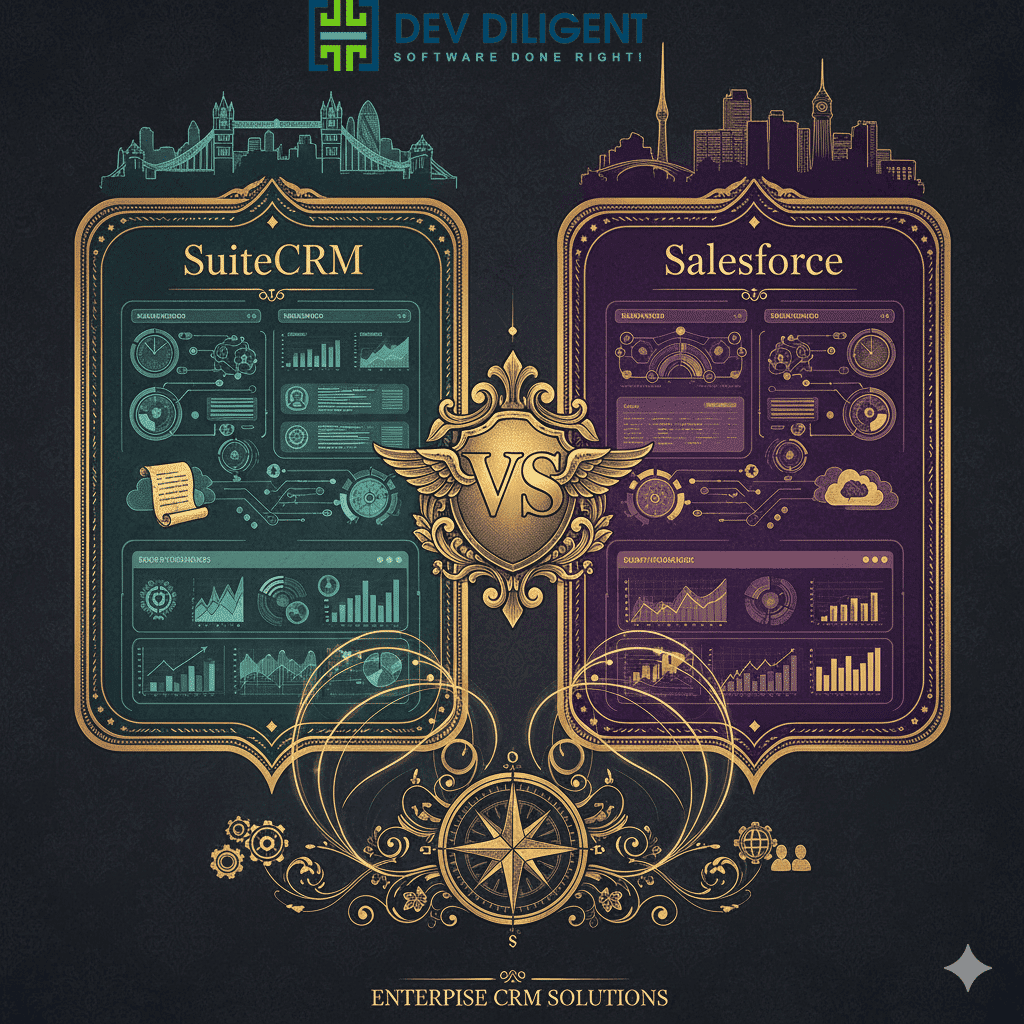
Quick Comparison Table: SuiteCRM vs Salesforce for UK & Irish SMEs (2026)
| Feature / Factor | SuiteCRM | Salesforce |
| Pricing | Free core software; paid support | High subscription cost per user |
| Ideal for | SMEs, custom workflows, open-source flexibility | Large enterprises, structured sales teams |
| Customisation | Deep customisation; open code | Highly customisable but add-ons costly |
| Deployment | Self-hosted or cloud | Cloud only |
| Data Ownership | Full control | Salesforce servers |
| Integration Cost | Low with open-source options | High for advanced integrations |
| Support | SuiteCRM consultants (London, Manchester, Dublin) | Vendor-managed only |
| Best Use Case | SMEs needing tailored business flows | Organisations needing enterprise-grade automation |
What Does Suite CRM Offer?
SuiteCRM is an open-source CRM platform widely recognised for its ability to deliver enterprise-level CRM functionality without licensing fees. Built as a fork of SugarCRM’s last open-source release, it offers:
- 1. Full code access
- 2. Flexible SuiteCRM development for advanced modules
- 3. End-to-end SuiteCRM implementation for SMEs across the UK
- 4. Integration options for logistics, finance, manufacturing & field services
- 5. Lower long-term TCO for SMEs in Dublin, Birmingham, Glasgow & Belfast
SuiteCRM is often selected by SMEs that require a CRM customised around operations—not a CRM forcing operations to adapt.
What Does Salesforce Offer?
Salesforce remains a global CRM giant, delivering robust sales automation, enterprise-grade workflow engines, AI-powered insights, a rich app marketplace, and a highly scalable cloud environment. It continues to dominate large organisations with sizable sales teams, but price escalations, costly add-ons, and a tightly coupled ecosystem often create challenges for UK and Irish SMEs that need more agility and cost control.
Is SuiteCRM Really Free?
Yes, SuiteCRM itself is fully free under its open‑source license, but there are operational costs for hosting, setup and customization, ongoing support, and maintenance and security updates. For this reason, local SuiteCRM consultants in cities like London, Manchester, and Dublin play a crucial role in helping SMEs achieve a stable, reliable long‑term deployment.
Who Is Salesforce’s Biggest Competitor in 2026?
SuiteCRM, Microsoft Dynamics 365, Zoho CRM, HubSpot, and SugarCRM all remain major players in the CRM landscape. SuiteCRM stands out in the UK and Irish markets thanks to zero licensing fees, highly customisable workflows, a growing local SuiteCRM consulting ecosystem, and rapid adoption across logistics, freight forwarding, trade, and field service sectors.
Cost Breakdown for SMEs: SuiteCRM vs Salesforce (2026)
Salesforce Cost Factors:
- 1. Annual licenses per user
- 2. Extra charges for workflows, storage, API access
- 3. AppExchange modules
- 4. Implementation & support fees
SuiteCRM Cost Factors
- 1. Hosting (shared, private, cloud)
- 2. SuiteCRM development for modules
- 3. Open-source CRM integration
- 4. Optional support plans
SuiteCRM cost for Dublin SMEs, in particular, remains significantly lower—often up to 70% cheaper long-term compared to Salesforce.
Core Differences That Matter to UK & Irish SMEs
1. Open-Source Flexibility vs Vendor Lock-In
– SuiteCRM enables complete control over data, hosting, and code.
– Salesforce restricts modifications to its internal architecture.
2. Customisation Level
– SuiteCRM development services allow any process to be automated—logistics, freight workflows, field service dispatching, financial pipelines, and more.
– Salesforce enables customisation but at higher cost and complexity.
3. Ownership and Compliance
UK and Irish SMEs, especially in regulated sectors, prefer SuiteCRM for its:
- – Local hosting
- – GDPR-aligned control
- – No global server reliance
Top Salesforce Alternatives in 2026
- 1. SuiteCRM
- 2. Microsoft Dynamics
- 3. Zoho CRM
- 4. HubSpot CRM
- 5. Sage CRM
- 6. SugarCRM
- 7. Pipedrive
- 8. Zendesk Sell
SuiteCRM remains particularly strong among SMEs seeking lower TCO and full ownership.
Which CRM Is Better for UK & Irish SMEs in 2026?
SuiteCRM Wins For:
- 1. Cost efficiency
- 2. Open-source customisation
- 3. On-premise or private cloud hosting
- 4. Industry-specific workflows
- 5. SMEs seeking scalable, tailored CRM ecosystems
Salesforce Wins For:
- 1. Large enterprises
- 2. Businesses with predefined sales flows
- 3. Organisations needing advanced enterprise features out-of-the-box
For most UK & Irish SMEs, SuiteCRM’s flexibility, lower cost, and local consulting ecosystem make it a more strategic long-term investment.
Recommended CRM Choice in 2026: SuiteCRM
SuiteCRM stands out as a future‑proof CRM platform thanks to its extensive community support, affordable consulting ecosystem, and strong availability of open‑source CRM services in hubs like Dublin and London. It enables quick implementations for SMEs across the UK and adapts well to logistics, freight forwarding, finance, and service-based sectors, making it a smart choice for businesses prioritising agility, cost efficiency, and full system control.
Final Thoughts
2026 places SMEs at a pivotal point where CRM strategy can directly influence customer experience, internal efficiency, and competitive advantage.
SuiteCRM’s open-source architecture and Salesforce’s enterprise ecosystem each bring strengths, but the flexibility, low cost, and customisation potential of SuiteCRM continue to make it a high-value CRM choice across the UK and Ireland.