Most SMEs in the UK and Ireland, whether based in London, Manchester, Birmingham, Dublin, or Cork are re-evaluating their CRM systems in 2026. With rising SaaS subscription costs, data privacy priorities, AI automation needs, and industry-specific workflow requirements, the traditional “one-size-fits-all” CRM model is rapidly losing its effectiveness.
This guide provides a complete details and comparison between Custom CRM Development and Off-the-Shelf CRM Solutions, using updated 2026 data, SME case insights, and local market trends. It also outlines when businesses should choose each option, how costs differ, and how modern open-source CRM development is changing the UK–Ireland landscape.
Why SMEs Are Switching Away from SaaS CRMs in 2026
In 2026, many SMEs are moving away from SaaS CRMs because what once seemed affordable quickly becomes expensive when more users, integrations, or automation are added. Businesses frequently end up paying £300–£1,000+ per month due to per‑user pricing, while still facing limited workflow support for sectors like logistics, real estate, healthcare, finance, recruitment, and field services, along with data residency concerns under GDPR UK and the ROI Data Protection Act. At the same time, they lack full control over customization, API limits, and analytics, just as the need for mobile‑first, AI‑driven, automation‑heavy CRMs is rising, making custom CRM development a significant competitive advantage for SMEs.
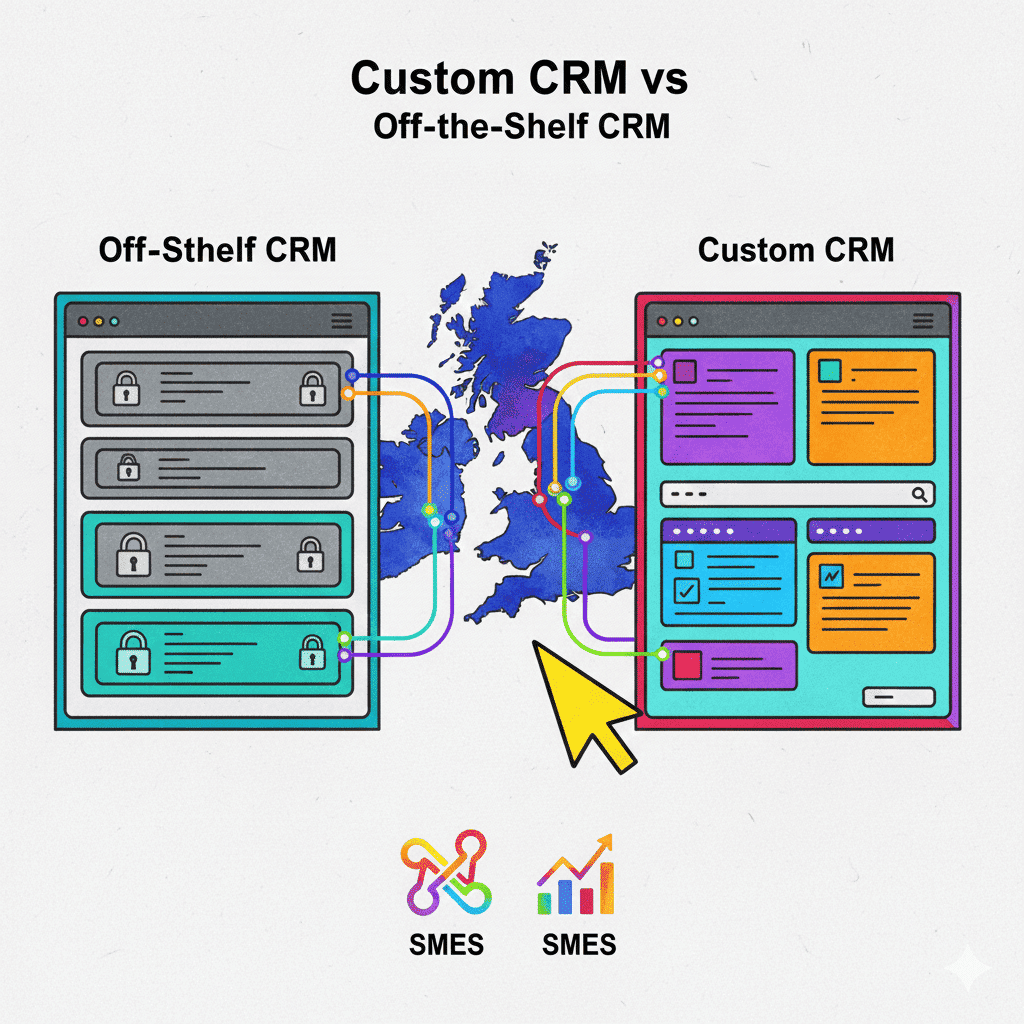
Custom CRM vs Off-the-Shelf CRM — 2026 Comparison Table
| Feature / Factor | Custom CRM Development | Off-the-Shelf CRM (SaaS) |
| Initial Cost | Medium–High (one-time) | Low upfront, high long-term |
| Long-Term Cost | Low (no per-user fees) | High (monthly + user-based pricing) |
| Customization | Complete & unlimited | Limited to vendor constraints |
| Industry Fit | Perfect for niche workflows | Generic workflows |
| Scalability | Unlimited, fully flexible | Restricted by plan limits |
| Data Ownership | 100% owned by business | Shared with SaaS provider |
| Hosting | Cloud, private server, or AWS | Controlled by SaaS vendor |
| Integrations | Custom integrations possible | API limits, extra charges |
| AI & Automation | Fully tailored | Limited to platform tools |
| GDPR Compliance | Full control | Vendor-dependent |
| Support | Dedicated/custom | Shared, ticket-based |
| Best for | SMEs with unique workflows | Simple sales teams |
When Off-the-Shelf CRMs Work Best and When They Fail
Good For : Off‑the‑shelf CRMs work best for micro businesses with 1–4 users, startups that need a quick launch, and companies managing simple deal pipelines using tools such as HubSpot, Zoho, or Pipedrive.
Limitations : However, in 2026 their limitations are becoming clearer: costs can explode as user counts grow, API-based automation often requires higher‑tier paid plans, industry‑specific features are limited, control over data storage is constrained, and implementing truly custom workflows can be difficult or expensive.
When Custom CRM Wins for SMEs in 2026
Custom CRM is ideal when a business needs:
- 1. Tailored workflows (e.g., logistics dispatching, property management, healthcare compliance, construction tasking)
- 2. Complex modules like multi-branch operations, internal audits, advanced reporting, or field team management
- 3. Custom mobile apps
- 4. Deep integrations (ERP, accounting, HR systems)
- 5. Full GDPR control
- 6. Rapid scaling without user fees
There is strong local demand for custom CRM development across major UK and Ireland cities, with use cases such as a custom CRM for a logistics company in Manchester, bespoke CRM development in London for fintech compliance, and a custom CRM developer in Birmingham focusing on manufacturing workflows. In Ireland, businesses increasingly seek custom CRM solutions in Dublin for healthcare and wellness platforms and in Cork for education and membership systems, reflecting how sector-specific needs are driving tailored CRM projects in these regions.
Cost Comparison: Custom CRM vs SaaS CRM (2026 UK–Ireland Pricing)
UK Pricing (London, Manchester, Birmingham)
| CRM Type | SME Annual Cost | Notes |
| Custom CRM | £15,000–£60,000 one-time | Full ownership, scalable |
| SaaS CRM | £6,000–£35,000 per year | Increases with users |
Ireland Pricing (Dublin, Cork)
| CRM Type | SME Annual Cost | Notes |
| Custom CRM | €18,000–€55,000 one-time | GDPR control, open-source options |
| SaaS CRM | €5,000–€32,000 per year | Add-ons priced separately |
Open Source CRM Development Is Exploding in 2026
Open-source CRM development is rapidly gaining traction in 2026, with SMEs in Dublin, Cork, Manchester, and Birmingham increasingly choosing platforms like SuiteCRM, OroCRM, and Laravel-based systems. This approach allows businesses to avoid user-based pricing, own the full source code, customize any module, retain data within national borders, and deploy on AWS, DigitalOcean, or on‑premise infrastructure. As a result, open-source CRMs are becoming especially popular among logistics providers, freight and transport companies, nonprofits, healthcare and wellness organisations, real estate agencies, and trades and service businesses that need flexible, cost-effective, and compliance-friendly CRM solutions.
Custom CRM Benefits for SMEs (2026)
Custom CRM solutions offer major benefits for SMEs in 2026, including no per-user fees, fully customisable workflows, and advanced reporting with KPI tracking. They can also provide AI-based recommendations, mobile CRM apps, and full data ownership, while automating tasks, follow-ups, and audits. Additionally, tight integrations with ERP, HR, finance, and marketing systems help create a unified, efficient business stack.
Real-World Scenarios
| Scenario | Requirements | Outcome |
| Scenario 1: Logistics SME in Manchester | Truck scheduling, driver tracking, fleet maintenance, billing, and a customer portal | SaaS CRM couldn’t support workflows → chose custom CRM with a mobile driver app |
| Scenario 2: Wellness Organisation in Dublin | GDPR-compliant contact tracking, session logs, assessments, and care plans | Implemented an open-source custom CRM with AWS hosting |
| Scenario 3: Trades Business in Birmingham | Job scheduling, invoice automation, and onsite mobile reporting | Built a custom CRM with a Flutter mobile app |
What Works Better for SMEs in 2026?
When deciding between custom and off‑the‑shelf CRM, the choice often depends on complexity and scale. Unique workflows, the need for custom mobile apps, large teams, or heavy automation usually point toward a custom CRM. In contrast, when budgets are tight and the team is small, an off‑the‑shelf CRM is often the more practical starting point.
Build a Custom CRM That Fits the Business — Powered by DevDiligent
DevDiligent specializes in creating fully tailored CRM systems designed around real operational workflows rather than generic, restrictive software structures. For SMEs in the UK or Ireland, a custom CRM can be built using modern stacks such as Laravel, SuiteCRM, open-source frameworks, cloud infrastructure, and mobile-ready architecture. The development process includes requirement scoping, feature mapping, integration planning, modular architecture design, MVP-first delivery, and long-term scaling options. Every system is engineered to support automation, efficiency, analytics, and seamless team collaboration.
DevDiligent also provides ongoing support, maintenance, security updates, API integrations, and cloud hosting—ensuring the CRM continues to evolve with growing business needs. Start the journey with a tailored cost estimate and develop a CRM system built around the actual workflow, eliminating the need to adjust operations to fit rigid software limitations.