The world of app development has officially entered its “smart era” — and Laravel 11 is at the center of it. Businesses aren’t just building apps anymore; they’re building AI-powered ecosystems, connected dashboards, automation engines, intelligent customer experiences, and predictive systems that make decisions in real time.
Laravel has always been a favorite among developers, but in 2026, it’s breaking new ground. With Laravel 11, enhanced performance tools, security features, and built-in support for advanced integrations, companies are increasingly choosing Laravel as the backbone of their AI-driven applications.
Let’s break down why Laravel + AI is the hottest combo in the tech world.
Why AI Integration Became Essential in 2026
In 2026, artificial intelligence is no longer just a “cool feature”—it has become the cornerstone of modern business technology, redefining how organizations compete and grow. Companies across Saudi Arabia, the UAE, and globally now consider AI a must-have for their digital solutions, not a luxury.
AI now powers core business functions, driving:
-
– Workflow Automation:
Businesses leverage AI to automate repetitive tasks, streamline processes, and free up staff to focus on strategic opportunities. From order processing to marketing triggers, AI ensures operations run faster and with fewer errors. -
– Hyper-Personalization:
AI tracks customer preferences, buying history, and web interactions in real time, tailoring communications, product recommendations, and support to each user—boosting engagement and satisfaction. -
– Predictive Customer Behavior:
Smart algorithms analyze data from multiple sources to forecast customer needs, identify churn risks, and discover upsell opportunities, equipping sales and marketing teams to anticipate demand and act proactively. -
– Data Enrichment:
AI can instantly enhance existing databases with missing details, spot patterns, and deliver deeper insights—helping businesses build smarter, more complete customer profiles. -
– Fraud Detection:
Machine learning models recognize suspicious patterns, flag anomalies, and proactively protect businesses from financial and data fraud—crucial in finance, eCommerce, and regulated industries. -
– Instant Communication (AI Chatbots & Voice Agents):
Real-time AI-powered chatbots and voice agents handle queries, booking, support requests, and more at any hour, providing seamless experiences and reducing wait times for customers. -
– Intelligent Dashboards:
Modern dashboards now use AI to turn complex data into actionable insights, surfacing trends, visualizing forecasts, and recommending next steps—empowering leaders to make rapid, data-driven decisions. -
– Smart eCommerce Recommendations:
AI analyzes browsing, purchase history, and preferences to suggest products with pinpoint accuracy, driving higher conversion rates and larger order values.
With these capabilities, businesses want apps that truly “think” and learn. The arrival of Laravel 11 has made advanced AI integration easier than ever—removing technical barriers and heavy overhead. Now, even small teams or startups can embed AI-driven automation, chat agents, predictive analytics, and data enrichment into their core business platforms.
What’s New in Laravel 11 for AI-Driven Development?
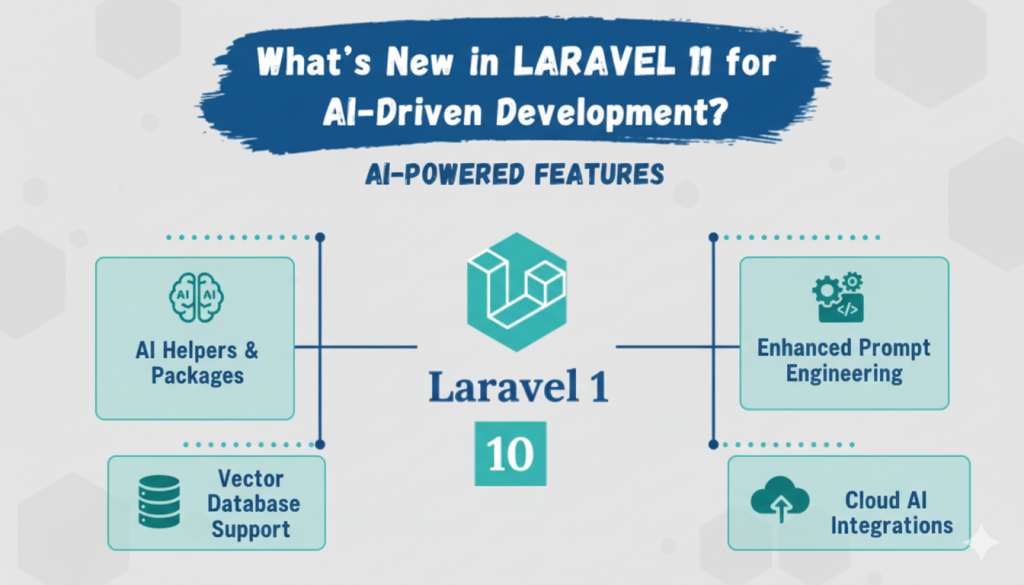
Laravel 11 introduces features that developers have been waiting for — and they directly support high-performance AI applications.
1. Cleaner, Faster Core
Laravel 11 is designed with a slimmer core, giving you:
- – Faster load times
- – Better API performance
- – Reduced server resource usage
Perfect for AI workloads that require speed.
2. Native Task Scheduling Improvements
AI apps run:
- – background jobs
- – queues
- – analytics pipelines
Laravel 11 improves task scheduling with more efficient workers and reduced downtime.
3. Laravel Octane Boost
If you add Octane, you can get:
- – 5x–10x performance speed
- – Persistent memory
- – Real-time AI-powered dashboards
Meaning your AI API calls respond in milliseconds.
4. First-Class Support for Modern PHP 9
The evolution of PHP 9 has ushered in a new era of performance for web applications and digital platforms across Saudi Arabia, the UAE, and beyond. With its cutting-edge engine, PHP 9 delivers lightning-fast compilation, reduced latency, and unparalleled efficiency—making it the ideal foundation for scalable business solutions.
When paired with Laravel 11, this combination becomes a powerhouse for developers and businesses alike:
-
– Crazy Fast Compilation:
PHP 9’s advanced JIT (Just-In-Time) compiler and optimized runtime enable code to execute nearly instantaneously. This means websites, CRMs, and complex business apps built in Laravel 11 load quicker and handle more traffic without the usual delays. -
– Ultra-Low Latency:
Business-critical operations—such as real-time reporting, instant transactions, and live chat—benefit from PHP 9’s ultra-low latency, ensuring users get smooth, responsive experiences every time. -
– Maximum Efficiency:
The new engine minimizes memory usage and accelerates request processing, lowering server costs and supporting green IT initiatives by improving energy efficiency—an important factor for enterprises and data centers in the GCC. -
– Laravel 11 Optimization:
Laravel 11 is engineered to harness the latest features of PHP 9, supporting async execution, modern syntax, and robust security enhancements. This synergy means you get the best of both worlds: rapid prototyping and enterprise-grade performance. -
– Built for the Future:
Together, PHP 9 and Laravel 11 offer business owners, agencies, and development teams a platform ready for AI integration, API-first workflows, and seamless cloud scalability—ensuring your technology investment stands the test of time.
5. Authenticity + Encryption Upgrades
AI apps handle sensitive data → Laravel 11’s new authentication system & encryption layer ensure compliance.
How Laravel Integrates With AI in 2026
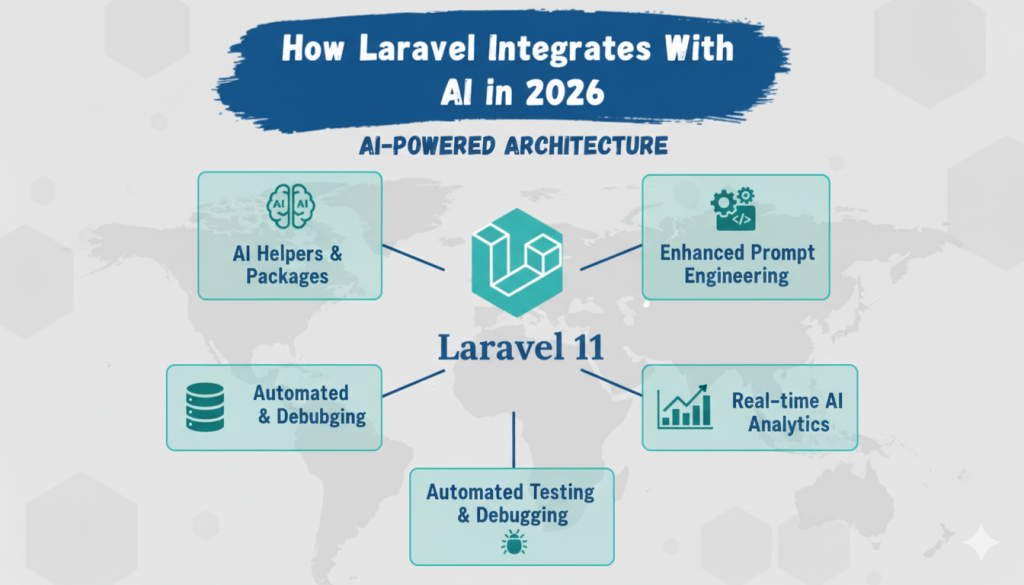
Laravel makes AI integration smooth because it plays nicely with:
1. OpenAI GPT Models (chatbots, content, instructions)
Using the Laravel OpenAI packages, you can build:
- – AI chatbots
- – AI-based support systems
- – Content generation
- – Research assistants
2. Laravel + Python (Machine Learning Pipelines)
Laravel can call:
- – TensorFlow models
- – LangChain
- – Scikit-learn
- – Vision models
Great for predictive analytics, fraud detection, and smart dashboards.
3. AI Image Recognition & OCR
Laravel + Vision AI =
- – Document extraction
- – Invoice reading
- – Face recognition
- – Object detection
4. AI Recommendation Engines
Perfect for eCommerce:
- – Personalized product suggestions
- – Upsell predictions
- – Customer segmentation
5. Voice & Text AI Agents
Laravel-based apps can integrate:
- – Whisper (speech-to-text)
- – AI voice bots
- – Phone automation systems
These are trending heavily in 2026 SaaS apps.
Real-World Use Cases (2026 Business Examples)
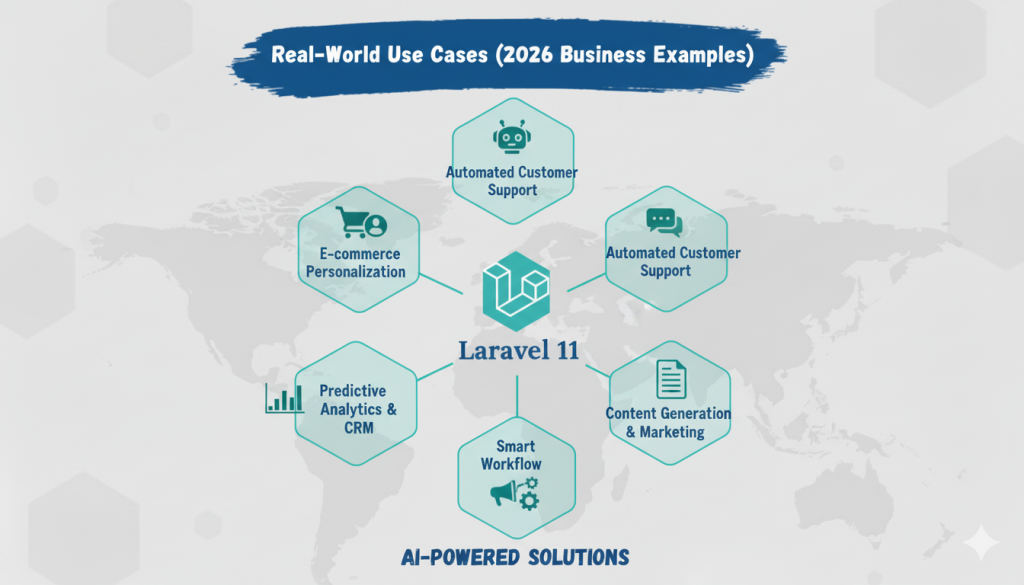
1. AI-Powered SaaS Platforms
Startups are building:
- – Automated social media posting platforms
- – Content generation apps
- – AI analytics dashboards
All using Laravel as their main engine.
2. Smart E-Commerce Stores
Laravel powers:
- – AI-driven pricing
- – Demand forecasting
- – Customer behavior prediction
- – Automated product tagging
3. AI Customer Service Systems
Companies are embedding:
- – Chatbots
- – Voice bots
- – AI ticket classification
This reduces support workload by 60–80%.
4. Healthcare & Medical Apps
Laravel + AI is used for:
- – medical image analysis
- – appointment prediction
- – patient communication tools
5. Enterprise Automation Tools
Corporations use Laravel for:
- – workflow automation
- – internal tools
- – data routing systems
Why Developers Prefer Laravel for AI Projects
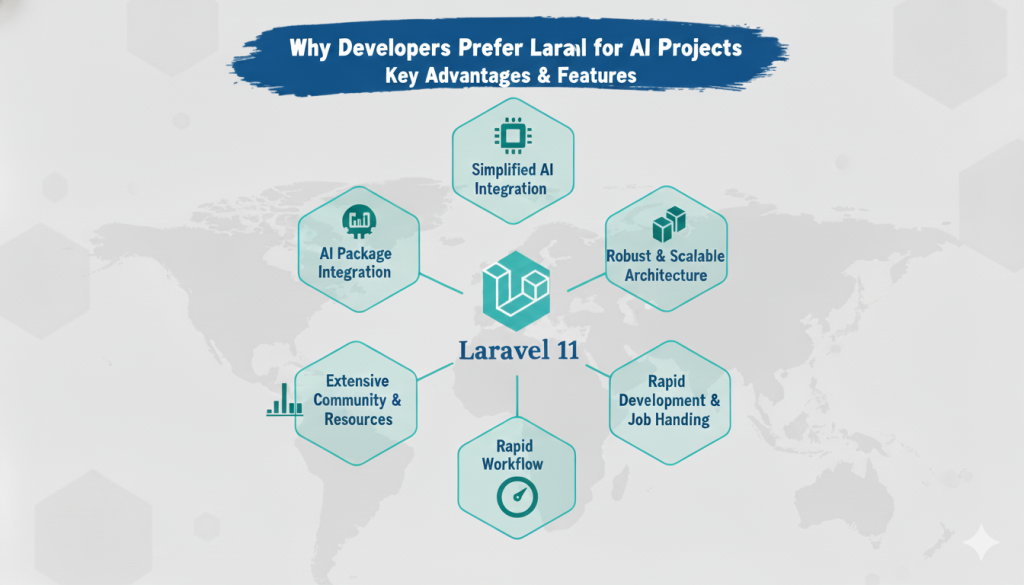
Easy integrations
Laravel’s ecosystem gives ready-to-use AI packages.
Strong security
Essential for data-sensitive AI tasks.
Fast API performance (especially with Octane)
AI apps thrive on low response times.
Blade + Vue/React compatibility
You can build smart dashboards quickly.
Mature ecosystem & documentation
This reduces development time and cost.
AI + Laravel: The 2026 Development Workflow
Here’s how modern Laravel teams build AI products:
- Laravel handles the core app, auth, routing, dashboards
- AI models run through APIs (OpenAI, Gemini, Llama) or Python services
- Queues manage background AI tasks
- Octane accelerates speed
- Redis + caching improves prediction response time
- Vite + Vue/React build interactive AI dashboards
This workflow is becoming the new standard.
Laravel 11 vs Laravel 10 (AI & Performance Comparison Table)
| Feature | Laravel 11 | Laravel 10 | Impact on AI Development |
|---|---|---|---|
| Performance Speed | Ultra-optimized core with PHP 9 support | Optimized but slower in heavy load | Faster AI responses, smoother API calls |
| Octane Performance | More stable with 5–10x speed boost | Stable but older version | Enables real-time AI dashboards & faster pipelines |
| Task Scheduling | Improved queue handling & background processes | Good but slower under pressure | Ideal for ML tasks & automation |
| Security Layer | Upgraded encryption & authentication | Standard security | Safer handling of AI data & user information |
| API Efficiency | Lightweight routing + faster response times | Moderate performance | Better integration with AI models & services |
| AI Compatibility | Improved support for OpenAI, Python ML & vector tools | Supported but not optimized | Reduces latency, improves workflow smoothness |
Futur Predictions: The Next Evolution of Laravel AI Apps
By 2027, expect:
- – Native Laravel AI helper tools
- – Built-in vector database support
- – Better AI caching
- – Automatic code generators
- – More AI-native packages
- – Real-time AI agents within apps
Laravel is moving toward being not just a PHP framework —
but a full AI web app engine.
Conclusion
Laravel 11 is built for a future where apps are smarter, more automated, and more connected than ever. With AI becoming a mandatory part of modern software, Laravel gives businesses the perfect mix of performance, security, flexibility, and developer-friendliness.
If you’re building the next SaaS product, eCommerce platform, dashboard, or custom business system — Laravel + AI is the tech stack that will keep you ahead in 2026.