Cost, ROI, Risks & a Smart Decision Framework — Short answer: a custom CRM can be worth it for small businesses in 2026, but only under specific, clearly defined conditions. This guide explains exactly when a custom CRM delivers measurable value, when it becomes an unnecessary expense, and how to avoid costly mistakes before committing resources.
Small businesses in 2026 operate in a very different environment than they did just a few years ago: customers now expect personalized, instant, and consistent experiences; teams are leaner yet required to perform at higher levels; AI-driven automation has become a necessity rather than an advantage; and subscription software costs continue to increase year after year.
Against this backdrop, founders and operations leaders are increasingly asking a critical question — is investing in a custom CRM a smart long-term move, or an avoidable risk? This guide provides a clear, evidence-based answer grounded in real CRM implementation patterns, long-term cost analysis, small business operational realities, and the technology and growth trends shaping 2026. No hype. No vendor bias. Just clarity.
What Is a Custom CRM (and How It’s Different in 2026)
A Customer Relationship Management (CRM) system centralizes customer data, sales activity, communication history, and operational workflows into a single source of truth, enabling better visibility and control across the business.
A custom CRM, however, is not a pre-packaged tool or a one-size-fits-all solution; it is purpose-built software designed specifically around a company’s sales process, service model, internal workflows, system integrations, and long-term growth roadmap. What makes 2026 fundamentally different is how custom CRMs have evolved beyond simple databases.
Modern implementations often include AI-assisted lead prioritization, intelligent workflow automation, predictive reporting, real-time operational dashboards, and API-first integration with ERP, accounting, logistics, and eCommerce systems. This shift has transformed CRM from a record-keeping tool into a performance engine and in doing so, it has changed the ROI equation entirely.
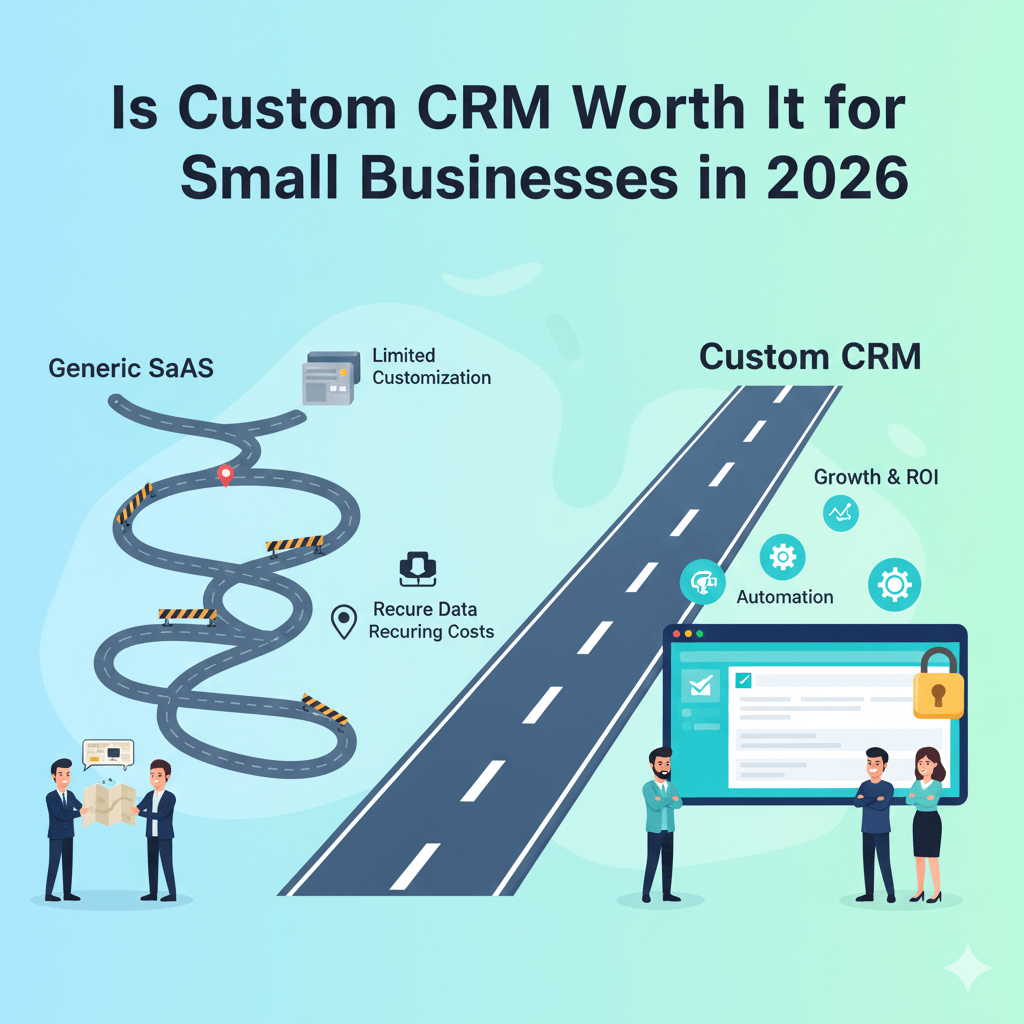
Custom CRM vs Off-the-Shelf CRM: The Reality (Not the Marketing)
Most small businesses start with SaaS CRMs and for good reason. But problems usually surface as the business grows
Side-by-Side Comparison
| Area | Off-the-Shelf CRM | Custom CRM |
| Setup Speed | Very fast | Slower (planned rollout) |
| Flexibility | Limited by vendor | Fully tailored |
| Integrations | Common tools only | Any system |
| Feature Bloat | High | None |
| Monthly Cost | Low → increases yearly | None |
| Long-Term Cost | Compounds | Predictable |
| Scalability | Tier-locked | Unlimited |
| Data Ownership | Vendor-controlled | Full ownership |
| Competitive Advantage | Shared | Unique |
Key insight: Off-the-shelf CRMs optimize for mass adoption. Custom CRMs optimize for business performance.
Why Custom CRM Is Gaining Momentum Among Small Businesses
This shift is not accidental. It’s driven by three structural changes.
1. Subscription Fatigue
Per-user pricing, feature gating, and forced upgrades significantly increase costs over time.
2. Process Complexity
Modern small businesses operate across:
- 1. Multiple channels
- 2. Multiple tools
- 3. Multiple teams
Generic CRMs struggle to reflect this reality cleanly.
3. Data as a Strategic Asset
Businesses increasingly rely on first-party data, something custom CRMs control far better.
The Real Benefits of Custom CRM (Beyond the Obvious)
1. Processes Work the Way the Business Actually Operates
Instead of forcing teams to adapt their daily workflows to rigid software limitations, a custom CRM is designed to adapt to the way teams actually work. By aligning the system with real operational processes, businesses see measurable improvements in data accuracy, higher user adoption, stronger accountability across roles, and faster execution of day-to-day tasks, ultimately turning the CRM into a practical productivity tool rather than an administrative burden.
2. Automation That Actually Saves Time
Custom automation is built around real workflows, not assumptions.
Examples:
- 1. Auto-assigning leads based on internal rules.
- 2. Triggering actions across multiple systems.
- 3. Eliminating manual reporting entirely.
3. Cleaner Data, Better Decisions
By eliminating unused fields, forced data entry, and structural inconsistencies, a well-designed custom CRM produces cleaner, more reliable data across the organization. This data clarity directly enables trustworthy reporting, faster and more confident decision-making, and more accurate forecasting, allowing leadership teams to plan growth and allocate resources based on insights they can actually rely on.
4. Long-Term Cost Control
While upfront costs are higher, long-term economics often favor custom CRM.
Example (3–5 Year View):
- 1. SaaS CRM: licenses + add-ons + integrations + upgrades.
- 2. Custom CRM: build + maintenance + controlled improvements.
Many businesses find the break-even point occurs sooner than expected.
5. Ownership & Security
A custom CRM ensures full data ownership, granular access control tailored to internal roles, alignment with regulatory and compliance requirements, and freedom from vendor lock-in. This level of control is especially critical in regulated or data-sensitive industries, where data governance, security, and long-term system reliability are not optional but essential to maintaining trust and operational stability.
The Hidden Risks (And Why Many Businesses Get This Wrong)
Custom CRM is powerful but not forgiving.
1. Over-Engineering:
Over-engineering occurs when a CRM is designed to address hypothetical future requirements rather than the business’s current needs. This approach often results in project delays, unnecessary complexity, and poor user adoption. The guiding principle is simple: build for today’s realities while designing the system to scale and evolve for tomorrow.
2. Unclear Requirements:
CRM failures almost always begin with unclear requirements. Without clearly defined objectives and measurable goals, even a technically well-built system can fail to deliver value, resulting in wasted time, resources, and missed opportunities.
3. No Adoption Strategy:
The success of a CRM is determined more by behavior than by technology. Even the most sophisticated system will fail without a solid adoption strategy, which includes thorough training, structured onboarding, and strong internal buy-in. Ensuring that teams understand, trust, and actively use the CRM is just as critical as the software itself.
4. Underestimating Maintenance:
Underestimating maintenance is a common pitfall with custom CRM implementations. These systems require regular updates, security patches, and ongoing feature refinement. Ignoring these responsibilities can quickly lead to technical debt, operational inefficiencies, and increased long-term costs.
Cost Breakdown: What Custom CRM Development Services Really Costs in 2026
Costs vary widely but transparency builds trust.
Typical Ranges
- 1. Basic custom CRM: $15,000 – $30,000.
- 2. Mid-complexity CRM: $30,000 – $60,000.
- 3. Advanced CRM with automation & integrations: $60,000+
What Influences Cost
- 1. Number of users.
- 2. Workflow complexity.
- 3. Integrations.
- 4. Reporting depth.
- 5. Automation level.
Important:
A phased build approach significantly reduces risk and cost.
When Custom CRM Is Worth It
A custom CRM makes strategic sense for small businesses when processes are unique or industry-specific, multiple systems need to integrate seamlessly, subscription costs are escalating, and full data ownership is essential. It is particularly valuable when growth is planned and deliberate rather than experimental, and when an existing CRM has become a constraint rather than a facilitator. In these scenarios, a purpose-built solution can drive efficiency, scalability, and long-term competitive advantage.
When It’s NOT Worth It
A custom CRM is typically not the best choice when a business model is still evolving, internal processes are undocumented, or budgets are constrained. It may also be unnecessary if an off-the-shelf CRM adequately meets current needs or if the team lacks the maturity to adopt and leverage a more complex system. In such cases, investing in a custom solution can be premature and may result in wasted resources or low adoption.
A Simple Decision Framework (Use This Before Investing)
Ask these five questions:
- Are current CRM limitations slowing operations?
- Are teams working around the system instead of with it?
- Are integrations critical to daily operations?
- Is long-term cost predictability important?
- Is customer experience a key differentiator?
If 3 or more answers are “yes,” custom CRM deserves serious consideration.
Summary:
Custom CRM is worth it for small businesses in 2026 when workflows are unique, scalability matters, data ownership is important, and long-term efficiency outweighs short-term convenience. For early-stage or standard operations, off-the-shelf CRM remains the better option.
Final Verdict: Is Custom CRM the Right Choice for 2026?
1. Yes — When approached as a strategic growth investment, not a quick fix
2. Yes — When implemented with clear goals, disciplined planning, and phased execution
3. No — When it’s treated as a replacement for core business strategy and fundamentals
Custom CRM isn’t just software. It’s a tool for control, operational clarity, and a measurable competitive edge. The right implementation transforms workflows, improves data visibility, and accelerates growth.
Planning a Custom CRM? Avoid Costly Missteps
Before committing to a CRM, ensure your investment drives results:
- 1. Validate Feasibility – Confirm your workflows and processes can be effectively supported
- 2. Estimate ROI – Understand the long-term cost savings and revenue potential
- 3. Identify Scope Risks – Pinpoint potential implementation challenges before they arise
Take action with confidence:
1. Get a Free Custom CRM Readiness Assessment
2. Request a CRM Cost vs ROI Analysis
3. Book a 30-Minute Strategy Call
Make CRM decisions backed by data, insight, and strategic guidance — not assumptions.