In 2026, customer relationship management is no longer a background system. It has become a core growth engine for small and mid-sized enterprises (SMEs). As competition intensifies, customer expectations rise, and data regulations tighten, CRM platforms increasingly determine how efficiently businesses scale.
For many SMEs across the UK and Ireland, the decision often comes down to Custom CRM development Services vs SaaS CRM platforms. While SaaS CRMs promise quick setup and predictable pricing, custom CRM solutions are gaining traction among growing businesses that need flexibility, control, and long-term cost efficiency.
This guide explores which CRM model actually scales for SMEs in 2026, using real operational factors rather than marketing claims.
Understanding the Two CRM Models
What Is a SaaS CRM?
A SaaS CRM is a subscription-based platform hosted and maintained by a vendor. Examples include Salesforce, HubSpot, Zoho, and Pipedrive. These platforms offer predefined features designed to serve a wide audience across industries.
Key characteristics:
- 1. Monthly or annual licensing fees.
- 2. Feature-based pricing tiers.
- 3. Limited customization.
- 4. Vendor-controlled infrastructure and updates.
SaaS CRMs work well for early-stage teams with simple workflows and limited integration requirements.
What Is a Custom CRM?
A custom CRM is purpose-built for a specific business or industry. It is designed around internal processes, data structures, and long-term growth plans. Custom CRMs are often built using open-source CRM frameworks or fully bespoke architectures.
Key characteristics:
- 1. Tailored workflows and dashboards.
- 2. Full data ownership.
- 3. Flexible integrations.
- 4. Scalable architecture aligned with business growth.
Custom CRM development services is increasingly adopted by SMEs transitioning from operational simplicity to process complexity.
Why CRM Scalability Is a Real Challenge for SMEs
Scaling a business introduces challenges that generic CRM platforms struggle to address:
- 1. Multiple departments with unique workflows.
- 2. Growing data volumes and reporting needs.
- 3. Integration with ERP, accounting, logistics, or mobile apps.
- 4. Compliance with GDPR and data residency requirements.
- 5. Rising subscription costs as teams expand.
In 2026, CRM scalability is less about adding users and more about supporting operational maturity.
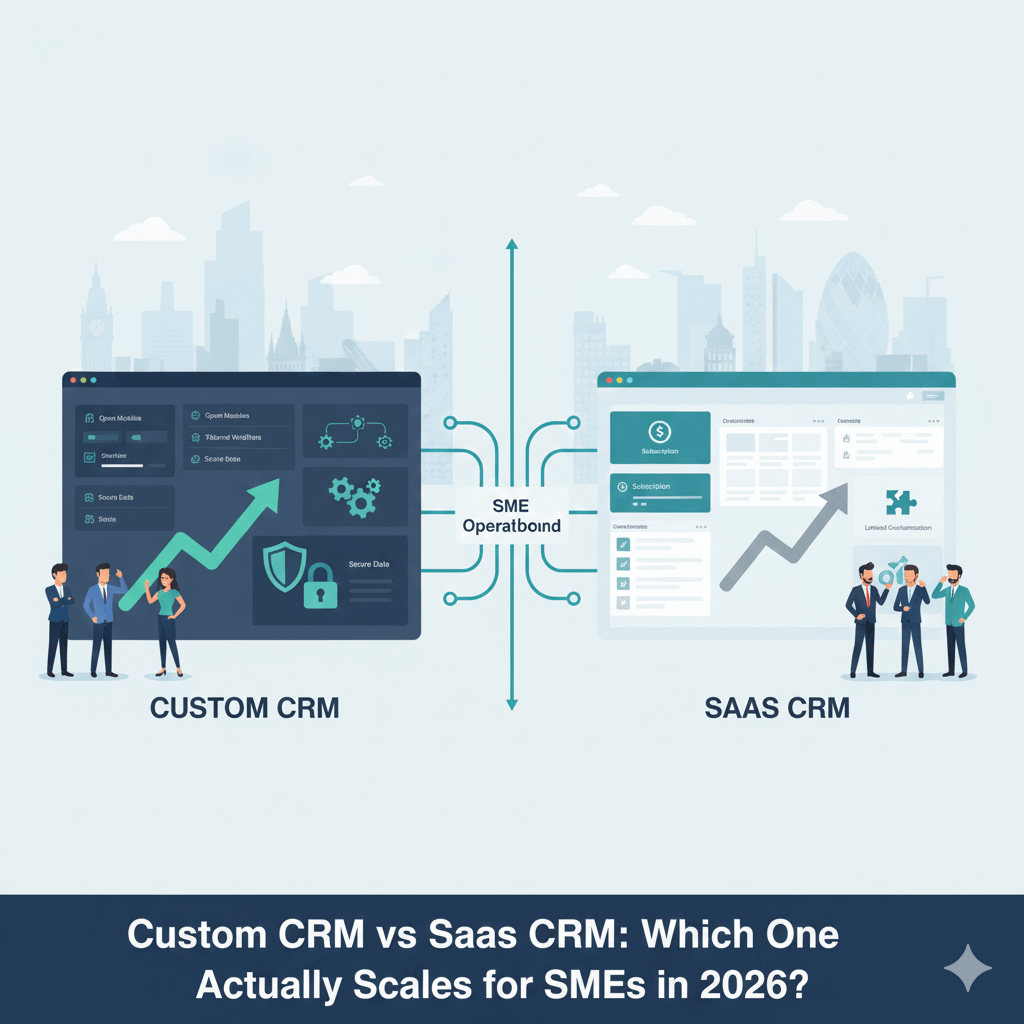
Custom CRM vs SaaS CRM: A 2026 Comparison
| Factor | SaaS CRM | Custom CRM |
|---|---|---|
| Initial Setup | Fast | Strategic planning required |
| Customization | Limited | Fully tailored |
| Scalability | Tier-based | Architecture-based |
| Data Ownership | Vendor-controlled | Fully owned |
| Long-Term Cost | Increases with users | Stable after build |
| Integrations | API-limited | Unlimited |
| Compliance Control | Shared | Full control |
Cost Reality: Short-Term Savings vs Long-Term Value
SaaS CRM Cost Growth
SaaS CRM pricing often appears affordable initially. However, as SMEs scale:
- User-based pricing increases exponentially
- Advanced features require higher-tier plans
- API access and automation incur additional fees
By 2026, many SMEs report paying multiple SaaS subscriptions just to compensate for CRM limitations.
Custom CRM Cost Efficiency
Custom CRM development involves upfront investment, but long-term financial impact tells a different story:
- No per-user licensing fees
- Features built once, used indefinitely
- Infrastructure costs scale with usage, not seats
For SMEs planning sustained growth, custom CRM solutions often become more cost-effective within 18–24 months.
Data Ownership & Compliance: A Critical 2026 Concern
With stricter data protection laws and increased awareness of vendor lock-in, data ownership has become a decisive factor.
SaaS CRM risks include:
- Limited control over data storage location
- Export restrictions
- Dependency on vendor policies
Custom CRM advantages include:
- Full ownership of customer and operational data
- Compliance-ready architecture
- Freedom to host data locally or regionally
For regulated industries and privacy-conscious SMEs, custom CRM platforms offer a significant strategic advantage.
Operational Flexibility: Where Custom CRM Wins
SaaS CRMs are built for the average use case. SMEs rarely operate on average workflows.
Custom CRM systems enable:
- Industry-specific pipelines
- Custom admin panels for operations teams
- Role-based access control
- Automation aligned with internal processes
This flexibility becomes critical in sectors such as logistics, professional services, manufacturing, and B2B sales.
When SaaS CRM Makes Sense
SaaS CRM platforms remain suitable for early-stage startups, small teams with simple sales processes, short-term projects, and businesses with minimal integration needs. For these cases, SaaS CRM offers speed and convenience without complex setup or custom development.
When Custom CRM Is the Better Scaling Choice
Custom CRM solutions are better suited for SMEs that have outgrown generic workflows, require deep system integrations, want predictable long-term costs, need full data ownership, and plan sustained growth beyond basic sales tracking. By 2026, these requirements are increasingly common rather than exceptional, making custom platforms the scalable choice for businesses ready to move beyond SaaS limitations.
The Role of Open-Source CRM in Custom Development
Open-source CRM frameworks like SuiteCRM and Perfex provide a powerful middle ground for custom development, offering reduced development time through pre-built modules, proven security models vetted by global communities, no licensing fees, and continuous innovation from active contributors. Many custom CRM solutions are built on these open-source foundations, combining enterprise-grade stability with the flexibility to tailor workflows, integrations, and interfaces exactly to business needs.
How DevDiligent Helps SMEs Scale with Custom CRM
DevDiligent specializes in custom CRM development and open-source CRM consulting for SMEs across the UK and Ireland.
The approach focuses on:
- Business-first system design
- Scalable backend architecture
- Secure admin panels
- Seamless integrations with existing tools
- Long-term maintainability
Rather than forcing businesses to adapt to software, DevDiligent designs CRM systems that adapt to business operations.
Free CRM Scalability Assessment (2026 Edition)
Many SMEs continue using SaaS CRMs without understanding the long-term cost and scalability impact.
This free assessment includes:
- CRM cost vs growth analysis
- Workflow scalability review
- Data ownership risk evaluation
- Custom CRM feasibility insights
– Request the Free CRM Assessment
Decision Framework: Custom CRM or SaaS CRM?
Choose SaaS CRM if:
- The business is in early growth stages
- Standard sales tracking is sufficient
- Long-term customization is not required
Choose Custom CRM if:
- Operations are becoming complex
- SaaS costs are rising faster than revenue
- Data control and integrations are critical
- Growth strategy extends beyond 2–3 years
Final Thoughts: Which CRM Actually Scales in 2026?
In 2026, CRM scalability is defined by adaptability, ownership, and operational alignment, not brand popularity.
While SaaS CRM platforms continue to serve early-stage needs, custom CRM solutions increasingly power SMEs that aim for sustainable growth, efficiency, and strategic independence.
For businesses planning beyond short-term convenience, custom CRM development services is no longer a luxury — it is a competitive advantage.
FAQ’s About Custom CRM vs SaaS CRM