Customer Relationship Management (CRM) platforms are entering a decisive phase in 2026. Across the UK and Ireland, organisations are no longer treating CRM as a simple contact database — it has become the operational core for sales, marketing, customer success, and decision-making.
Driven by AI maturity, stricter data regulations, rising customer expectations, and rapid SaaS adoption, CRM trends in 2026 reflect a shift toward intelligent, compliant, and experience-led systems. This guide breaks down the top 10 CRM trends shaping businesses in the UK & Ireland.
Why CRM Trends Matter in 2026 for UK & Irish Businesses
From London-based SaaS firms and Manchester SMEs to Dublin fintech startups and Belfast logistics providers, CRM strategies are evolving due to:
- 1. Growing adoption of AI-powered customer engagement
- 2. UK GDPR and EU GDPR compliance pressures
- 3. Demand for personalised, omnichannel experiences
- 4. Increased competition across B2B and B2C sectors
Staying aligned with CRM innovation in 2026 is no longer optional — it directly impacts revenue growth, customer retention, and operational efficiency.
1. AI-Driven CRM Becomes the Standard, Not a Feature
Artificial intelligence is now deeply embedded into modern CRM systems. In 2026, UK and Irish businesses are adopting CRMs that go beyond automation and deliver predictive, decision-ready intelligence.
Key advancements include:
- 1. Predictive sales forecasting using historical deal data
- 2. AI-driven lead scoring and opportunity prioritisation
- 3. Automated customer insights based on behaviour patterns
- 4. Natural language queries inside CRM dashboards
AI-powered CRM platforms are particularly gaining traction among UK SaaS companies, Irish technology firms, and enterprise service providers seeking data-backed decision-making at scale.
2. Hyper-Personalisation Across the Full Customer Lifecycle
Generic outreach is rapidly losing effectiveness. CRM platforms in 2026 are enabling real-time personalisation across marketing, sales, and customer support.
This trend focuses on:
- 1. Behaviour-based segmentation
- 2. Dynamic content recommendations
- 3. Personalised follow-ups triggered by CRM activity
- 4. Unified customer timelines across channels
Businesses operating in competitive UK and Ireland markets are using CRM-driven personalisation to increase engagement, conversion rates, and customer lifetime value.
3. CRM as a Central Revenue Operations (RevOps) Hub
CRM platforms are increasingly acting as the foundation for Revenue Operations (RevOps) — aligning sales, marketing, and customer success under one system.
In 2026, CRM trends show:
- 1. Shared data models across teams
- 2. Unified KPIs and reporting dashboards
- 3. Automated handoffs between departments
- 4. Reduced data silos across tools
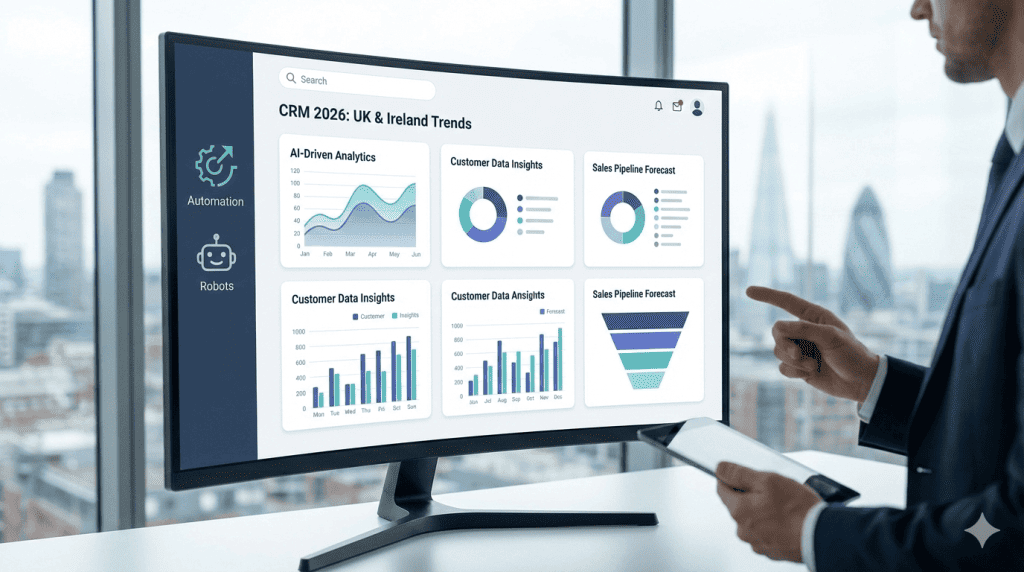
UK-based B2B companies and Irish professional services firms are adopting CRM-led RevOps models to improve forecasting accuracy and pipeline visibility.
4. Privacy-First CRM Design for UK & EU Compliance
With UK GDPR and EU GDPR enforcement becoming stricter, CRM vendors are prioritising privacy-by-design architectures.
Modern CRM systems now include:
- 1. Granular consent management
- 2. Role-based access controls
- 3. Data residency options for UK and EU hosting
- 4. Automated data retention and deletion policies
This trend is particularly relevant for financial services, healthcare, education, and public-sector organisations across the UK and Ireland.
5. No-Code and Low-Code CRM Customisation
CRM platforms in 2026 are increasingly built for business users, not just developers. No-code and low-code tools allow rapid customisation without technical complexity.
Key capabilities include:
- 1. Visual workflow builders
- 2. Drag-and-drop dashboards
- 3. Custom modules without coding
- 4. Automated business logic creation
SMEs in the UK and Ireland are adopting flexible CRM systems to reduce implementation costs while maintaining scalability.
6. Industry-Specific CRM Solutions Gain Momentum
One-size-fits-all CRM solutions are being replaced by industry-focused CRM platforms tailored to specific workflows.
Popular vertical CRM adoption in 2026 includes:
- 1. CRM for logistics and freight forwarding
- 2. CRM for real estate agencies in the UK
- 3. CRM for healthcare providers in Ireland
- 5. CRM for manufacturing and supply chains
Industry-aligned CRMs improve adoption rates and reduce the need for heavy custom development.
7. Deeper CRM Integration with ERP and Business Systems
CRM platforms are no longer operating in isolation. Integration with ERP, accounting, HR, and analytics systems is a defining CRM trend for 2026.
Common integrations include:
- 1. CRM + ERP for order-to-cash visibility
- 2. CRM + accounting software for revenue tracking
- 3. CRM + marketing automation platforms
- 4. CRM + customer support systems
UK and Irish enterprises are prioritising unified data ecosystems to enable faster decision-making and improved reporting accuracy.
8. Real-Time Analytics and Decision Intelligence
Static reports are being replaced by real-time CRM analytics. In 2026, CRM platforms deliver live insights that support proactive actions.
Advanced analytics capabilities include:
- 1. Real-time pipeline health monitoring
- 2. Customer churn prediction
- 3. Performance benchmarking across regions
- 4. AI-assisted insights for managers
This trend supports leadership teams across the UK and Ireland who rely on data-driven strategies to stay competitive.
9. Mobile-First CRM for Distributed Teams
With hybrid and remote work firmly established, CRM vendors are prioritising mobile-first CRM experiences.
Modern mobile CRM features include:
- 1. Offline data access
- 2. Mobile approvals and task updates
- 3. Voice-to-CRM data entry
- 4. Secure mobile authentication
Sales teams across the UK and Ireland are increasingly dependent on mobile CRM platforms to stay productive on the move.
10. Ethical AI and Transparent Automation in CRM
Trust is becoming a core CRM differentiator. In 2026, businesses are demanding ethical AI practices within CRM systems.
This includes:
- 1. Transparent AI recommendations
- 2. Explainable automation logic
- 3. Bias-aware data models
- 4. Human-in-the-loop decision workflows
CRM vendors that prioritise transparency and accountability are gaining stronger adoption across regulated UK and EU markets.
Key Takeaways: CRM Strategy for 2026
The CRM landscape in the UK and Ireland is moving toward intelligent, compliant, and experience-centric platforms. Businesses investing in AI-ready, privacy-first, and industry-aligned CRM solutions are best positioned for sustainable growth in 2026 and beyond.
Organisations evaluating CRM upgrades should focus on:
- 1. AI maturity and data intelligence
- 2. Compliance readiness for UK & EU regulations
- 3. Integration capabilities with existing systems
- 4. Long-term scalability and user adoption
CRM Capabilities: 2025 vs 2026 (UK & Ireland Edition)
| Feature / Capability | CRM Trends in 2025 | CRM Advancements in 2026 | Why It Matters (UK & Ireland) |
| AI & Automation | Basic AI assistance (templates, basic scoring) | Predictive intelligence with actionable insights | Better forecasting & reduced manual workload |
| Personalisation | Segment-based messaging | Real-time behaviour-driven personalisation | Higher engagement across UK & Irish audiences |
| Revenue Operations (RevOps) | Siloed team views | Unified RevOps dashboards & workflows | Stronger alignment between teams |
| Compliance & Data Privacy | Standard GDPR controls | Privacy-first design + granular consent tools | Meets stricter UK/EU regulations |
| Customisation | Limited no-code workflows | Robust low-code & no-code capability | Faster configuration for SMEs |
| Industry-Specific CRM | Early adoption | Widespread adoption across verticals | Tailored CRM for finance, healthcare, real estate |
| System Integrations | Core integrations (ERP / Marketing) | Deep ecosystem sync across all business systems | End-to-end visibility for UK enterprises |
| Analytics | Static dashboards | Real-time decision intelligence | Proactive strategy adjustments in competitive markets |
| Mobile Experience | Mobile access only | Full mobile-first workflow + offline support | Supports hybrid work trends |
| AI Ethics & Transparency | Emerging consideration | Built-in explainable AI & bias supervision | Trust and compliance critical in regulated sectors |
Final Thoughts
CRM trends for 2026 signal a shift from reactive customer management to predictive, insight-driven engagement. UK and Irish businesses that align their CRM strategy with these trends will gain measurable advantages in customer experience, operational efficiency, and revenue performance.
Staying informed, choosing the right CRM architecture, and prioritising data trust will define CRM success in the year ahead.