Open source CRM platforms are experiencing their biggest wave of innovation to date. What was once a cost-saving alternative is now becoming core infrastructure for organizations seeking flexibility, security, AI-driven intelligence, and freedom from vendor lock-in.
As we step into 2026, the open source CRM landscape is dominated by major updates, vertical-focused solutions, AI automation, DevSecOps maturity, and a fast-growing global community.
This deep analysis combines latest vendor releases, security transformations, AI innovations, and market predictions to help developers, CTOs, and business leaders make strategic decisions.
Short answer: In 2026, open source CRM continues to evolve with stronger automation, tighter AI integration, API-first architectures, and community-driven features. Businesses must balance flexibility with support and implementation capability to maximize ROI.
Want expert insights on which open source CRM fits your 2026 business goals?
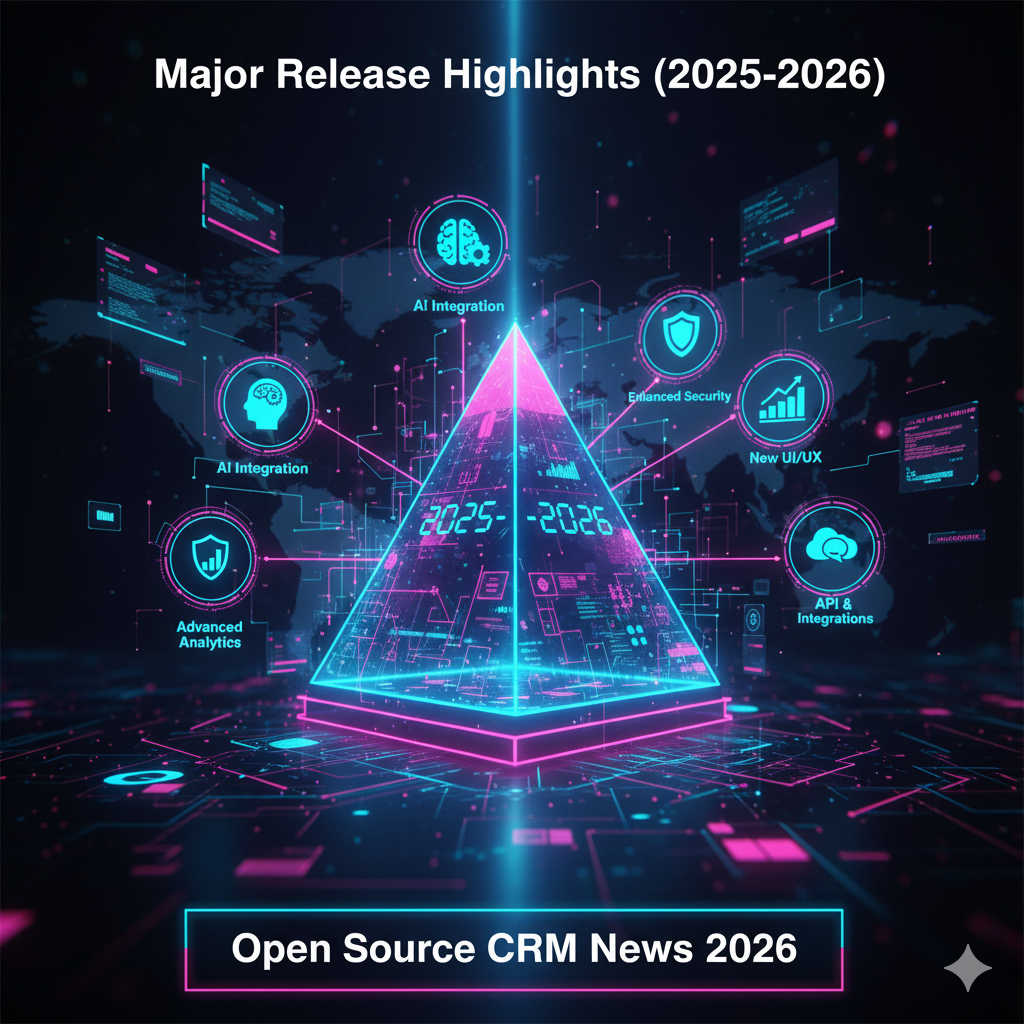
Get Free CRM Strategy PlanMajor Release Highlights (2025–2026)
1. SuiteCRM 8.9.1 & 7.14.8 — A New Era of Stability & AI Readiness
SuiteCRM continues to lead with its November 2025 release featuring:
- – 40+ bug fixes & community enhancements
- – Improved compatibility with MySQL 8
- – Performance optimizations in workflows, campaigns & email modules
- – Better cloud deployment support
- – Continued ESR (Extended Support Release) migration support
2026 Roadmap Preview:
- – AI-driven dashboards
- – Predictive sales analytics
- – Dynamic reports
- – Faster cloud-syncing engines
SuiteCRM’s growing ecosystem with Open Collective funding and global contributor recognition, keeps the platform strong, stable, and future-ready.
2. Odoo 18 — The CRM + ERP Intelligent Powerhouse
Odoo’s latest release is pushing it firmly into enterprise territory.
Key updates:
- – Upgraded marketing automation and omnichannel communication
- – Deep CRM–ERP integrations
- – Enhanced supply chain, HR, and inventory sync
- – A redesigned sales pipeline experience
- – Faster performance for multi-company setups
AI CRM extensions for 2026 include:
- – Predictive deal forecasting
- – Intelligent lead routing
- – Workflow auto-generation
- – Contextual sales recommendations
With its global hackathons, add-on marketplace, and strong documentation culture, Odoo remains the most “complete ecosystem” in the open source CRM world.
3. EspoCRM 8.0 — Lightweight, Developer-Friendly & Modern
EspoCRM has secured its niche as a flexible, modular CRM favored by agencies and SMBs.
New improvements include:
- – Cleaner, modern UI
- – Real-time notifications
- – Faster workflow engine
- – Improved API for microservices
- – Easy custom module development
- – Stripe & payment integrations
- – Transparent community governance
Its rapid-release cycle and pro-dev philosophy make it one of the most reliable lightweight CRMs in 2026.
4. Dolibarr & YetiForce — Vertical-Focused CRM+ERP Platforms
Dolibarr is strengthening its position with:
- – Better invoicing and accounting
- – GDPR-aligned compliance options
- – Modular ERP + CRM scalability
- – New project management tools
YetiForce, popular in NGOs and EU companies, offers:
- – High-level security
- – Calendar, project & task management
- – Advanced permission controls
- – Optimized user experience for case management
Both platforms are gaining traction due to regulatory compliance, low-cost hosting, and industry-focused modules.
Key Open Source CRM Options and How 2026 Trends Affect Them – Comparison Table
| CRM | AI & Automation | API Support | Customization | Best Use |
|---|---|---|---|---|
| SuiteCRM | Moderate | Strong | High | SMBs & Custom Workflows |
| EspoCRM | Basic / Plugins | Good | Moderate | Simple CRM Needs |
| ERPNext (CRM Module) | AI via Integrations | Very Strong | Very High (ERP Breadth) | Enterprise + Cross-Functional |
| Odoo CRM | Growing | Good | High | Modular Suites |
Not sure how 2026 CRM trends affect your business?
Book Free CRM ConsultationThe Rise of AI & Automation in Open Source CRM (Biggest 2026 Trend)
AI is becoming a default feature, not an optional plugin.
Across most open source CRMs, you will now see:
Top AI Features (2026):
– Predictive lead scoring
– AI-based forecasting
– Smart email & proposal drafting
– Automated journey mapping
– Data cleansing & enrichment
– NLP-powered chatbots & support bots
– AI-assisted workflow building
– Context-aware deal routing
Architecture Trends Driving AI Adoption:
- 1. Seamless deployment on AWS, Azure, Google Cloud
- 2. Vector databases for CRM knowledge indexing
- 3. Private LLMs for data-secure automation
- 4. Improved API connectivity for multi-step agents
AI has officially leveled the playing field with expensive CRMs like Salesforce and HubSpot.
Security, DevSecOps & SBOM: The New Standard
Regulatory and security pressure is transforming how open CRMs are built.
2026 Security Trends:
- 1. Mandatory SBOM (Software Bill of Materials) requirements
- 2. Continuous vulnerability disclosures
- 3. Faster release cycles for security patches
- 4. Adoption of OpenSSF scorecards
- 5. Routine dependency scanning in CI/CD
- 6. Hardened Docker images for self-hosted deployments
- 7. Zero-trust access controls for CRM modules
SuiteCRM, Odoo, and EspoCRM now provide SBOMs by default, making them enterprise-ready for regulated industries.
Customization, Integration & Marketplace Growth
The plugin ecosystem is exploding.
Popular Add-ons Across CRM Marketplaces:
- 1. Accounting & billing modules
- 2. WhatsApp, Mailchimp, HubSpot connectors
- 3. Workflow automation systems
- 4. Payment gateways (Stripe, PayPal)
- 5. E-commerce & inventory connectors
- 6. Reporting & dashboard builders
- 7. Multi-tenant support tools
Businesses can now build an entire “industry stack” using open source CRM + add-ons + microservices.
The rise of low-code/zero-code tools inside CRMs (especially Corteza, ERPNext, and Odoo) makes customization faster and cheaper than ever.
Developer & Community Ecosystem: Stronger Than Ever
Key community moves shaping 2026:
- 1. SuiteCRM’s Open Collective boosts transparency & contributor funding
- 2. Odoo’s hackathons attract global developers
- 3. Major improvement in REST, GraphQL & webhook documentation
- 4. Freelancers building niche CRM modules for marketplaces
- 5. Agencies offering “CRM + microservices” for custom automation
- 6. Strong R&D direction from community councils
Open source CRM is now a career path—developers, freelancers, and integrators are in high demand.
What’s Next for 2026 & Beyond (Predictions)

1. Verticalized CRM Expansion
Expect industry-ready CRMs for:
Healthcare, finance, logistics, real estate, NGOs, manufacturing, education.
2. AI-driven process mapping
CRMs will soon auto-generate entire workflows from a few prompts.
3. Zero-code/low-code dominance
Business teams will build CRM modules without touching code.
4. Greater interoperability
Stronger connectors for:
E-commerce → Shopify, WooCommerce
Project management → Jira, ClickUp
Communication → WhatsApp Cloud API, Telegram, Slack
Social → Facebook, Instagram & TikTok messaging
5. Managed open CRM hosting
Affordable, fully managed cloud hosting bundles will accelerate adoption.
Conclusion: Open Source CRM in 2026
Open source CRM is no longer a niche solution — it is a strategic business platform.
The combination of:
- 1. AI-powered automation
- 2. Stronger security & SBOM compliance
- 3. Global community contributions
- 4. Industry-focused modules
- 5. Low-code customization
- 6. Affordable hosting
Makes open source CRM the smartest choice for growing businesses in 2026.
Organizations choosing open CRM now gain flexibility, transparency, control, and long-term cost efficiency — without resigning themselves to vendor lock-In.
Ready to Leverage Open Source CRM in 2026?
Tell us your CRM goals and we’ll deliver a tailored plan — implementation, customization, and long-term strategy.
Schedule Free CRM Strategy Call